A small patio asks more of a sofa than a big terrace does. On a wide deck, a piece can be handsome and slightly wrong and still work. In six square metres, every centimetre of depth, every arm height, every dark cushion shows up. The good news is that compact outdoor spaces tend to produce the most comfortable rooms in a house, precisely because nothing in them is accidental. What follows is the order in which it makes sense to decide: measure first, choose the job second, materials third, and only then start looking at shapes and finishes.
1. Measure the Space, the Route, and What You Want to Keep
Start with a tape measure and a notebook, not a catalogue. Measure the patio at its widest and at its narrowest point, because few are perfect rectangles. Note the depth from the wall or railing to the edge, and write down everything fixed: the door swing, a drainpipe, an outside tap, a step, the air-conditioning unit, the planter you are not willing to move.
Then measure the route in. A sofa that fits the patio but not the side gate is a sofa in a hallway. Check gate and doorway widths, the turn on the stairs, and whether the piece arrives flat-packed or assembled. If the frame comes in one piece, the narrowest point on the journey decides what you can buy.
Finally, decide how much empty space you are protecting. As a working rule, leave around 60–70 cm of clear floor between the sofa and any wall, planter or table you need to pass, and a little more on the main walking line. Mark the footprint on the ground with painter's tape or sheets of newspaper, then live with it for a day or two. The outline will tell you more than any dimension list.
2. Decide What the Sofa Is Actually For
A patio sofa earns its space by doing a specific job. Two people who want a coffee and a long conversation have different needs from a household that occasionally seats five for aperitivo, or one person who wants to read with their legs stretched out.
- Conversation for two: a two-seater or a deep armchair pair. Roughly 130–160 cm wide and 75–85 cm deep is a common range, but check the actual dimensions of the piece you like.
- Flexible seating: a bench or a backless daybed against a wall, with loose cushions that can be stacked away. It reads lighter than a sofa and doubles as a surface.
- Occasional crowds: a compact sofa plus two folding chairs stored indoors. The folding chairs do the extra work; the sofa stays small.
- Dining and lounging: a corner bench built around a small table, which uses the corner that a straight sofa wastes.
Be honest about the number. A sofa bought for the eight guests who come twice a year will crowd out the two people who sit there every evening.
3. Choose Materials That Match Your Weather and Your Storage
Frames
Teak and eucalyptus weather to a soft grey and last decades, but they are heavy and want occasional cleaning and oiling if you prefer the original honey colour. Acacia is affordable and sturdy, though it moves more with moisture. Powder-coated aluminium is light, rust-free and easy to shift when you want to sweep underneath, which matters on a small patio where furniture gets moved constantly. All-weather wicker over an aluminium frame gives texture without bulk. Concrete and stone-look pieces look wonderful and stay exactly where you put them, which is either the point or a problem.
No outdoor material is maintenance-free. A cover, a dry corner and a wipe-down twice a season will do more for longevity than any marketing claim.
Cushions and textiles
Look for quick-dry foam and solution-dyed acrylic covers with removable, zipped cases you can wash. On a compact patio, thin seat pads store more easily than thick upholstered cushions and dry faster after rain. If you have nowhere dry to keep cushions, plan for a bench-style sofa with a storage box nearby, or choose a piece that looks deliberate without cushions at all.
4. Judge the Visual Weight, Not Just the Dimensions
Two sofas of identical width can feel completely different in a small space. Low backs, open legs, slatted seats and pale finishes let the eye travel past the furniture to the wall and the planting. Thick arms, skirted bases and deep buttoned backs close the space in.
Watch the contrast too. A dark frame against a pale wall draws a hard outline and looks bulkier than the same sofa in a light finish. If your patio is shaded or narrow, an open-leg design in a mid or light tone buys you a surprising amount of air. Arm height is worth checking against window sills and railings, and back height against whatever you want to see over it.
5. Test the Layout Before You Buy
Once you have a candidate, dry-run the arrangement at full scale. Cardboard boxes, dining chairs and tape are enough.
- Mark the sofa footprint exactly, including the depth of any reclined back or open arms.
- Stack boxes to the seat height and the back height. Sit against them. Check whether you can see the garden or only the wall.
- Walk the route from the door to the furthest chair carrying a tray. If you have to turn sideways, the sofa is too deep.
- Open the door fully, pull out the chairs, and check the shade at the hour you actually use the patio.
- Stand inside and look out through the window. The view from the kitchen is the one you will live with.
If the tape layout feels tight, move down one size rather than hoping it will settle. It rarely does.
6. Plan the Table, Rug and Storage at the Same Time
A sofa alone does not make a room. A low coffee table or a slim side table needs 40–45 cm of clearance in front of the seat so knees and cups have somewhere to go, and a rug should sit under the front legs at least, or under the whole arrangement if the patio is covered. Decide now where a small storage box, a folding side table or a stack of cushions will live, because that object is part of your floor plan too. One well-placed piece of shade — an umbrella base, an awning, a sail — often does more for usability than an extra 20 cm of seating.
A Short Checklist Before You Order
The tape measurements, including the route in, are written down. The tape outline on the ground still feels right after a weekend. You know how many people the sofa must seat on an ordinary evening, and how many only on special occasions. The frame suits your climate and your willingness to move it, the cushions have somewhere dry to go, and the design keeps its visual weight low. If all of that holds, the sofa will fit the patio rather than shrink it.
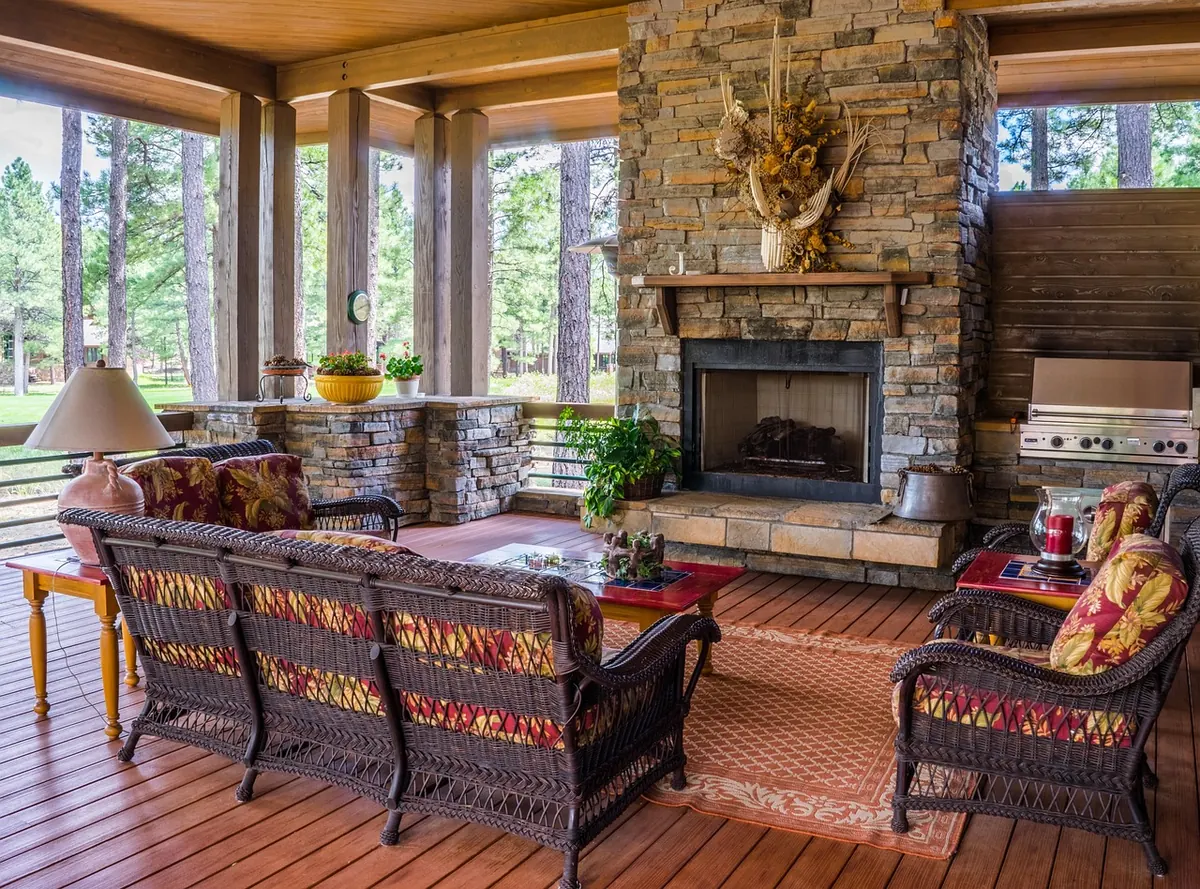
Photo: bedrck / Pixabay